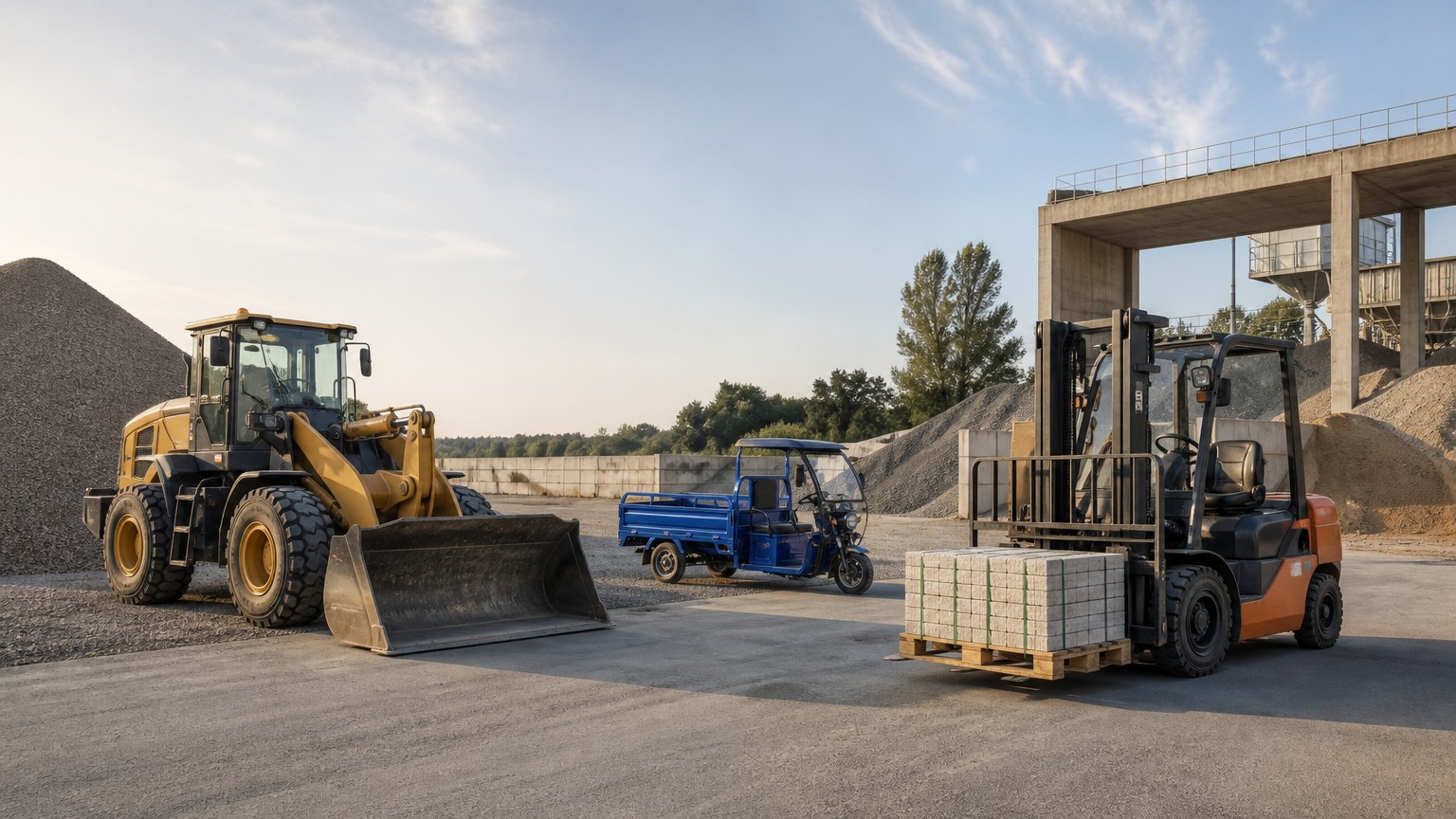
Wheel Loader vs Forklift vs Cargo Tricycle: Which Machine Fits Your Worksite?
When a worksite needs to move materials, the right machine depends on what the material must do next. A wheel loader is designed around loading and carrying bulk material with a bucket or compatible attachment. A forklift is designed to lift and place unit loads such as pallets. A cargo tricycle is designed to transport materials along a route in its cargo bed.
These machines solve different problems. Do not choose between them by comparing their advertised load figures alone: wheel-loader rated load, forklift capacity, and tricycle payload are not interchangeable measures. Start with the task, the material, the route, and the unloading point.
Quick comparison
| Machine | Best suited to | Typical movement | Questions to answer first |
|---|---|---|---|
| Wheel loader | Bulk materials such as soil, gravel, aggregate, feed, or similar loose loads | Scoop, lift, and carry over short site distances | What material, bucket or attachment, working surface, and loading height? |
| Forklift | Palletized or otherwise unitized loads that need to be lifted and placed | Pick up with forks, travel, and stack or position at a specified height | What is the load weight and center, lift height, mast, surface, and attachment? |
| Cargo tricycle | Bagged, boxed, or other cargo moved between work areas | Carry cargo in a bed along a defined route | What is the payload, route surface and gradient, travel distance, and unloading method? |
When should you choose a wheel loader?
Choose a wheel loader when the main job is handling loose or irregular bulk material. Typical tasks may include moving aggregate around a yard, loading material, or carrying farm and forestry materials over short distances. The machine's bucket and compatible attachments determine how it interacts with the material.
Before choosing a model, identify:
- The material's type, density, and typical volume per cycle.
- The loading point and required discharge height.
- The width and turning space available on the route.
- The ground condition, including mud, gravel, slopes, or uneven surfaces.
- Whether a standard bucket or another compatible attachment is required.
- The actual rated-load, bucket, engine, and operating-weight data for the exact configuration being quoted.
JINLONG's published JL wheel-loader page lists rated-load configurations from 0.6 to 3.0 tonnes and five model labels, JL06 through JL30. Treat these as listed configurations, not as a substitute for confirming the exact model specification and application with the supplier. View the JL wheel-loader product page.
When should you choose a forklift?
Choose a forklift when the material is handled as a unit load and must be lifted to a defined height—for example, palletized goods, packaged supplies, or materials staged for loading. Forklift selection depends on more than the nominal capacity printed in a product description.
Check the load's weight and dimensions, the load center, the required lift height, mast configuration, floor or terrain, and every attachment. OSHA explains that a forklift nameplate provides key machine information, including capacity, and that attachments can affect capacity, stability, and visibility. Operators should follow the nameplate for the actual truck-and-attachment configuration. OSHA forklift nameplate guidance · OSHA guidance on forklift attachments.
For outdoor or uneven worksites, do not assume an ordinary warehouse forklift is suitable. Confirm the machine's intended terrain, tires, drive configuration, ground clearance, and load chart with the supplier. JINLONG's published product range includes a 3-ton counterbalance forklift listing with diesel or electric power options; the actual configuration, mast, tires, and capacity plate should be checked for the intended job. View the 3-ton forklift product page.
When should you choose a cargo tricycle?
Choose a cargo tricycle when the main need is to move cargo between locations along a route, rather than to scoop bulk material or lift pallets to height. It can be considered for short-distance internal transport, agricultural hauling, or moving construction supplies where the route and operating conditions suit the vehicle.
Before selecting one, check:
- Payload for the exact model and body configuration.
- Cargo-bed dimensions and side-panel arrangement.
- Whether a dump bed or closed cabin is needed.
- Route width, surface, slope, and distance.
- Turning and reversing space at loading and unloading points.
- Local road-use, registration, safety, and emissions requirements.
- Whether cargo is loaded and unloaded manually or by another machine.
JINLONG's published diesel cargo-tricycle page lists a payload range of 500–1,000 kg and open-bed, dump-bed, and closed-cabin variants. Confirm the chosen version's approved payload, dimensions, and destination-market requirements before ordering. View the diesel cargo-tricycle product page.
Can one machine replace the other two?
Usually, not without trade-offs. A loader may move loose material efficiently but is not automatically the right choice for stacking pallets. A forklift can lift unit loads but is not designed to scoop bulk material with a loader bucket. A cargo tricycle can transport cargo along a route but does not replace a machine needed to load or lift that cargo.
Some machines can accept attachments or have specialized configurations. Verify compatibility, capacity, operating limits, and safety documentation for the exact machine and attachment combination. Do not assume that a physical fit means the combination is approved or suitable.
A simple selection sequence
- Describe the material: loose bulk, palletized/unitized goods, or cargo for transport?
- Describe the action: scoop and load, lift and place, or carry along a route?
- Measure the job: load weight, volume or dimensions, lift height, distance, and route width.
- Describe the surface: indoor floor, paved yard, gravel, mud, slope, or rough ground?
- List attachments and body options: include them before requesting a quote because they can change capability and capacity.
- Check local requirements: confirm safety, road-use, emissions, and conformity rules for the destination.
- Request a configuration-specific quotation: require the exact model, components, rated capacity or payload, operating limits, warranty, spare-parts information, and documents in writing.
Frequently asked questions
Is a wheel-loader rated load the same as a forklift capacity?
No. They refer to different machine types and operating conditions. Compare the exact machine's documentation and task limits rather than treating the figures as equivalent.
What information do I need before asking for a forklift quote?
Provide the load's weight and dimensions, load center, lift height, operating surface, mast requirement, and attachments. Then verify the capacity information for that exact configuration on the manufacturer's nameplate or load documentation.
Is a cargo tricycle suitable for every construction site?
No. Suitability depends on the route, surface, gradient, cargo, turning space, unloading method, and local operating requirements. Confirm these against the exact vehicle configuration.
Should I buy all three machine types?
Only if the work requires all three functions: bulk loading, lifting unitized loads, and route-based cargo transport. For a smaller operation, identify the bottleneck first and select equipment for that task.
What should I include in a supplier inquiry?
State the machine type, exact task, material or cargo, load data, route and surface, operating hours, required attachments, destination, and expected quantity. Ask for a matching specification sheet, capacity or payload documentation, manuals, warranty terms, parts information, and applicable compliance documents.
Sources
- JINLONG JL wheel loader product page: https://qingdaojinlong.com/en/products/jl-new-diesel-4x4-tractor-loader-log-fork-loader-1601367447737.html
- JINLONG counterbalance forklift product page: https://qingdaojinlong.com/en/products/jl-jinlonglutai-forklift-ce-iso-3ton.html
- JINLONG diesel cargo tricycle product page: https://qingdaojinlong.com/en/products/jl-best-selling-motorized-diesel-tricycle.html
- OSHA, Powered Industrial Trucks: Nameplate: https://www.osha.gov/etools/powered-industrial-trucks/types-fundamentals/parts/name-plate
- OSHA, Powered Industrial Trucks: Attachments: https://www.osha.gov/etools/powered-industrial-trucks/types-fundamentals/parts/attachments