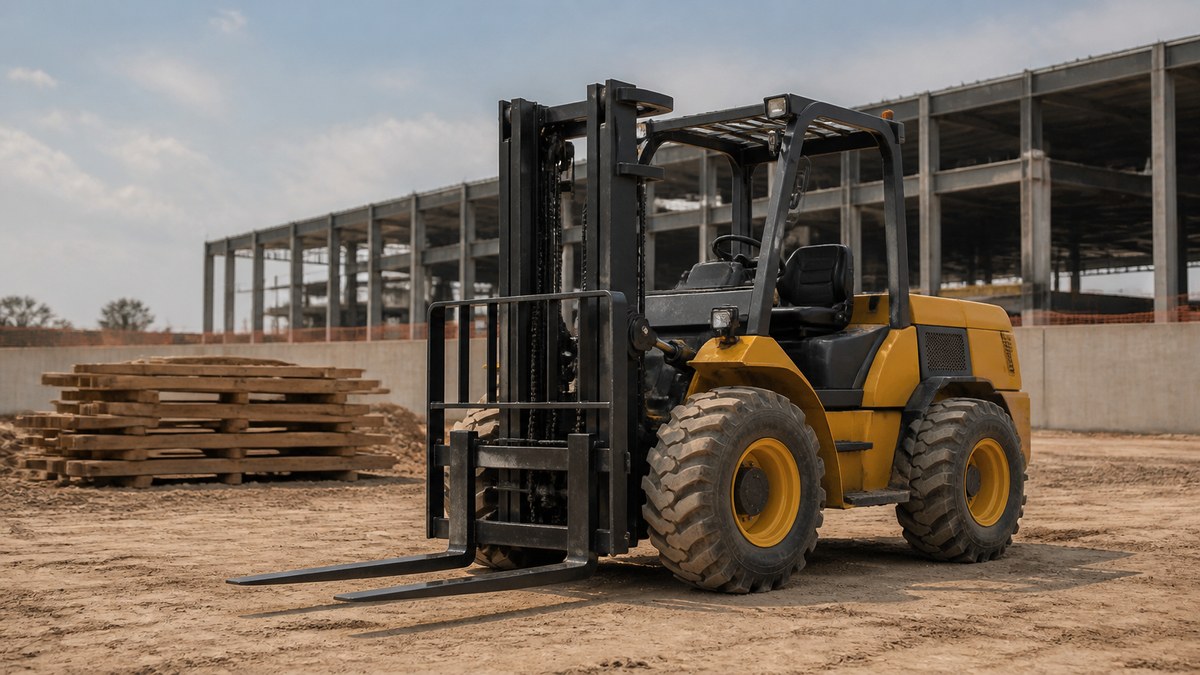
A rough terrain forklift is built for work that a standard warehouse forklift cannot handle. Construction sites, farms, timber yards, mining areas, and infrastructure projects often combine uneven ground, changing weather, limited access, and heavy loads. In these conditions, the right forklift is not simply the one with the highest rated capacity. It is the machine that can move safely, maintain stability, and keep working across the surfaces and distances found on your site.
This guide explains the main decisions buyers should make before requesting a quotation. Use it to define your operating requirements, compare configurations, and prepare a more accurate purchasing specification.
1. Start with the Worksite, Not the Brochure
Before comparing models, document the conditions in which the forklift will operate. A useful specification brief should answer five questions:
- What is the heaviest load, and what is its centre of gravity?
- How high must the load be placed?
- Will the machine travel on compacted soil, gravel, mud, slopes, or mixed surfaces?
- How far will it travel during a normal shift?
- Will it work indoors, outdoors, or between both environments?
The answers affect capacity, tire selection, drive system, mast height, ground clearance, and operator protection. A machine that performs well on a level yard may not be the right choice for a muddy construction entrance or a sloped agricultural site.
2. Match Rated Capacity to the Real Load
Rated capacity is usually the first number buyers compare, but it should not be considered in isolation. Forklift capacity changes with lift height, load centre, attachment type, and mast configuration. A load that is within the nominal capacity at a low height may require a lower safe capacity when lifted higher or moved with a longer attachment.
As a starting point, list the following for every major load:
| Requirement | What to record | Why it matters |
|---|---|---|
| Maximum load | Weight of the heaviest regular load | Defines the minimum capacity class |
| Load centre | Distance from the fork face to the load centre | Changes the effective lifting capacity |
| Load dimensions | Length, width, and height | Affects fork length and visibility |
| Lift height | Highest placement point | Determines mast selection and residual capacity |
| Attachment | Forks, rotator, clamp, or another tool | Adds weight and changes load geometry |
For mixed operations, avoid choosing a model based only on an occasional maximum load. Instead, identify the normal operating range and discuss the exceptional loads with the supplier. The final configuration should be confirmed through the manufacturer’s load chart and operating manual.
3. Why 4WD Matters on Unpaved Sites
Four-wheel drive is one of the defining features of a rough terrain forklift. It can improve traction and mobility when the machine travels across loose soil, gravel, grass, construction spoil, or other uneven surfaces. It is especially useful when the forklift must approach a load away from a prepared yard.
However, 4WD does not remove the need for safe site preparation. Operators still need to control speed, avoid unstable edges, and respect slope limits. Buyers should ask how the drive system, axles, differential, steering arrangement, and braking system work together. The objective is predictable control rather than simply adding a drive label to the brochure.
A 4WD configuration is generally worth prioritising when:
- Loads must be collected or delivered across unpaved ground.
- The site has frequent rain, loose material, or changing surface conditions.
- The forklift must cross ramps or moderate slopes within the approved operating limits.
- A project cannot rely on a fully paved loading area.
If the machine will operate almost exclusively on a flat, finished warehouse floor, a warehouse-oriented electric or diesel forklift may be a more efficient fit.
4. Choose Lift Height and Mast Configuration Carefully
Lift height should be based on the highest real placement point, not the tallest available option. A taller mast can provide useful stacking flexibility, but it can also affect overall height, visibility, stability, and transport planning. Measure doorways, container openings, low roofs, power lines, and other restrictions before selecting a mast.
Some rough terrain forklift configurations offer two-stage or three-stage mast options. The right choice depends on the combination of lift height, transport height, site clearance, and load handling frequency. Ask the supplier to provide:
- Closed mast height
- Maximum lift height
- Free lift height where relevant
- Forward and rear visibility at working height
- Residual capacity at the required lift height
- Mast configuration and available options
Do not compare two machines using maximum lift height alone. A complete comparison must include transport dimensions and the capacity available at the height you actually use.
5. Consider Engine and Fuel Requirements
Diesel power remains a practical choice for many outdoor construction and agricultural applications because refuelling is familiar and the machine can work away from charging infrastructure. Buyers should still match the engine and emissions configuration to the destination market, local fuel quality, service capability, and applicable regulations.
For export orders, confirm the following before placing an order:
- Engine make and model
- Rated power and torque information
- Required fuel grade and maintenance fluids
- Emissions or certification requirements for the destination
- Availability of filters, belts, hoses, and service parts
- Cold-start or high-temperature operating requirements
A lower purchase price is not an advantage if the engine configuration is difficult to support locally. The best choice balances initial cost with fuel access, service skills, parts availability, and expected operating hours.
6. Tires, Ground Clearance, and Stability
Tires are a major part of rough terrain performance. Pneumatic tires can provide useful cushioning and traction on changing ground, while the tire pattern and size influence flotation, clearance, and wear. Buyers should describe the most difficult surface rather than simply requesting “all-terrain tires.”
Important questions include:
- Is the surface mainly compacted soil, gravel, mud, rock, or mixed ground?
- Are punctures a common risk?
- Does the machine need to travel over debris or uneven transitions?
- What operating speed is expected?
- Is a spare tire or replacement plan required?
Stability also depends on wheelbase, axle design, load centre, mast position, tire condition, and operator behaviour. A high-capacity machine is not automatically safer. The complete machine and operating procedure must match the load and the terrain.
7. Select Attachments Around the Load
Standard forks are suitable for many palletised loads, but construction and agricultural buyers may need additional equipment. Common attachment questions include fork length, fork width, fork position adjustment, side-shift capability, clamps, rotators, and buckets.
Every attachment changes the operating profile. It may add weight, move the load centre forward, reduce residual capacity, or affect visibility. Ask for an attachment-specific load chart rather than assuming that the base machine capacity applies unchanged.
A clear attachment request should state:
- The load type and shape.
- The load dimensions and centre of gravity.
- The required movement, such as lifting, rotating, or tipping.
- The frequency of attachment changes.
- Whether the attachment must be shipped with the forklift or supplied separately.
8. Compare Three Configuration Priorities
For many buyers, the decision can be narrowed to three priorities: mobility, lifting flexibility, and ownership support.
| Priority | Configuration emphasis | Best fit |
|---|---|---|
| Mobility | 4WD, suitable pneumatic tires, ground clearance, robust axles | Unpaved construction, farms, outdoor yards |
| Lifting flexibility | Appropriate capacity, mast height, visibility, attachment options | Mixed loads and changing placement heights |
| Ownership support | Common engine, parts plan, manuals, warranty process | Remote sites and export fleets |
A good purchase specification does not maximise every feature. It identifies the two priorities that have the greatest effect on productivity and keeps the remaining options practical and serviceable.
9. Questions to Ask an Export Supplier
Before comparing quotations, request the same information from each supplier. This makes the offers easier to evaluate and reduces the risk of comparing different configurations under similar titles.
Ask for:
- A complete technical specification sheet
- Rated capacity and load charts
- Mast and transport dimensions
- Engine and transmission details
- Tire specification and ground clearance
- Standard equipment and optional attachments
- Certification documents applicable to the destination
- Warranty coverage and claim procedure
- Spare-parts list and recommended service kit
- Packing, shipping, and documentation details
For an export purchase, also confirm whether the quotation is based on EXW, FOB, or CIF terms and whether the listed configuration is the exact one shown in the quotation. Freight, import duties, inland transport, and local compliance costs should be evaluated separately from the factory price.
10. Jinlong Rough Terrain Forklift Options
Jinlong’s current product index includes several rough terrain forklift configurations for different capacity and lifting requirements. The 3.5-ton 4WD rough terrain diesel forklift is positioned for construction sites, farms, and mining operations. A related 3.5-ton configuration offers two-stage and three-stage mast choices with multiple lift-height options. The 4WD diesel rough terrain forklift range covers 3-to-7-ton capacity options for buyers who need a wider operating range.
Review the linked product pages for the current configuration, available specifications, and quotation details. Because the correct setup depends on the destination and the actual load, provide your worksite conditions before asking for a final recommendation.
Conclusion
The right rough terrain forklift is the result of matching the machine to the complete job: load weight, load centre, lift height, ground conditions, travel distance, attachments, local regulations, and after-sales support. Start with a written worksite brief, compare like-for-like specifications, and confirm the load chart for the exact configuration.
For buyers sourcing from China, a factory quotation should be only one part of the evaluation. Parts availability, documentation, warranty handling, and export experience can have a greater effect on long-term uptime than a small difference in the initial price.
If you are planning a construction, farming, mining, or outdoor material-handling project, contact the Jinlong team with your load details, required lift height, site conditions, destination country, and preferred delivery terms. We can then help you compare suitable rough terrain forklift configurations and prepare a quotation based on the actual application.