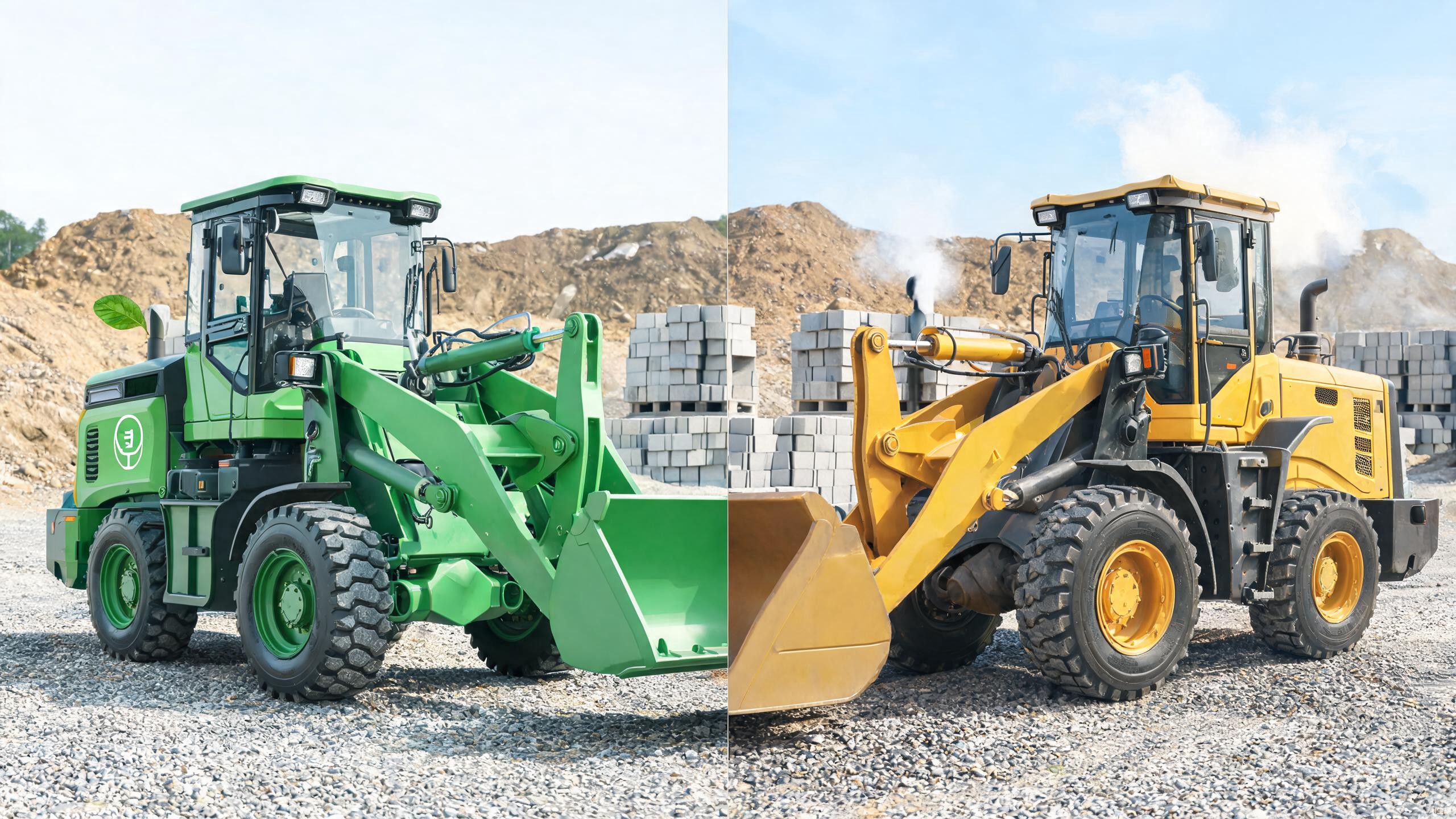
Choosing between an electric loader and a diesel loader is not a simple question of which technology is newer. The better choice depends on how the machine works during a shift: how often it moves, how long each cycle lasts, where it parks, how quickly it must refuel or recharge, and whether local technicians can support it.
This article presents a practical comparison for contractors, rental companies, farms, warehouses, and equipment dealers. It focuses on the operating decisions that are often missed in a brochure comparison.
The Short Answer
An electric loader is usually easier to justify when the worksite has predictable short cycles, reliable charging access, indoor or low-noise requirements, and a parking period long enough to recharge. A diesel loader remains more flexible when the machine works long outdoor shifts, moves between sites, operates far from the grid, or must return to service quickly after refuelling.
Neither conclusion should be made from engine power or battery capacity alone. The complete duty cycle matters.
1. Define the Duty Cycle
A duty cycle is the repeated pattern of work performed by the machine. Record the following for a normal shift:
- Loading time per cycle
- Travel distance with and without a load
- Average payload and peak payload
- Number of cycles per hour
- Idle time and waiting time
- Shift length and planned breaks
- Surface, slope, and temperature conditions
A loader working in a recycling yard may perform short, frequent cycles with regular pauses. A loader feeding a quarry truck may work continuously for many hours. The two jobs can require different power strategies even when their bucket size is similar.
2. Compare Energy Supply, Not Just Energy Cost
Diesel is stored energy that can be added quickly through refuelling. Electricity is supplied through a charging system whose output, connector, installation, and available time determine how much energy can be restored.
For an electric loader, ask:
- What electrical supply is available at the parking location?
- Is the charger included, optional, or supplied locally?
- How many hours are available for charging between shifts?
- Can the site support the required voltage and current safely?
- Is a backup plan available during an outage?
- Will the machine be moved to a second site?
For a diesel loader, ask:
- Is fuel consistently available at the jobsite?
- Can fuel be stored and handled safely?
- What is the expected fuel quality?
- How far is the service point from the site?
- How will fuel use be monitored?
The important comparison is not “fuel versus electricity” in the abstract. It is whether the energy system can support the actual production schedule.
3. Working Performance and Hydraulic Cycles
Loaders spend energy on more than travel. The hydraulic system lifts the arms, curls the bucket, positions the load, and returns the attachment. A buyer should therefore compare the complete working cycle rather than only the rated motor output.
Request the following information for both powertrains:
| Comparison point | Why it matters |
|---|---|
| Rated power and torque | Indicates available drive and working output, but not the complete cycle result |
| Hydraulic flow and pressure | Affects lift, bucket response, and attachment compatibility |
| Operating weight | Influences traction, ground pressure, and transport |
| Tipping load and rated load | Helps match the machine to the real payload |
| Cycle time under a defined load | Makes two machines easier to compare fairly |
| Continuous operating limits | Clarifies how the machine should be used during a long shift |
Electric motors can deliver controllable torque without the same engine-idling pattern as a diesel machine. That can be useful in stop-and-go applications, but it does not remove the need to size the battery and cooling system for the work.
4. Terrain, Weather, and Site Access
Electric loaders can be attractive in enclosed or noise-sensitive locations, but every site still needs a realistic environmental review. Check water exposure, dust, drainage, charging protection, ambient temperature, and the route to the charging point.
Diesel loaders often remain the more flexible option for remote or changing sites because they carry their energy source and can refuel away from a fixed electrical installation. In contrast, an electric machine may be a strong fit for a fixed yard where the same charging point is available every day.
For either machine, confirm tire type, ground clearance, articulation, braking, visibility, and transport dimensions. A powertrain cannot compensate for an unsuitable chassis or attachment.
5. Maintenance: Fewer Engine Parts Does Not Mean No Maintenance
Electric loaders generally avoid some diesel-engine service items, such as engine oil and fuel-system maintenance. They still require inspection of tires, brakes, steering, hydraulic oil, cooling paths, electrical connections, high-voltage safety components where applicable, and attachment wear parts.
Diesel loaders require a broader routine that can include engine oil, filters, fuel-water separation, cooling-system care, belts, exhaust components, and transmission service. The exact interval must follow the machine manual and engine supplier requirements.
When importing either type, the parts plan is as important as the service interval. Ask for a recommended start-up parts kit, part numbers, service manuals, warranty procedure, and remote troubleshooting process.
6. Total Cost of Ownership Worksheet
Avoid comparing only the purchase quotations. Build a five-year worksheet with the same categories for both options:
| Cost category | Electric loader | Diesel loader |
|---|---|---|
| Machine and attachments | Purchase configuration | Purchase configuration |
| Site energy equipment | Charger, protection, installation | Fuel storage and handling |
| Energy use | Electricity consumed in the defined duty cycle | Diesel consumed in the defined duty cycle |
| Scheduled maintenance | Hydraulic, electrical, tires, brakes, filters where fitted | Engine, fuel, cooling, hydraulic, tires, brakes |
| Downtime exposure | Charging delay, grid interruption, service delay | Fuel interruption, service delay, parts delay |
| End-of-life items | Battery and electrical components according to supplier terms | Engine, transmission, and emission components according to service life |
Use measured site data when possible. If energy prices, duty, taxes, or battery terms are unknown, mark them as assumptions instead of presenting a false precision.
7. A Decision Matrix for Buyers
| Site condition | Usually favours | Reason to investigate |
|---|---|---|
| Fixed yard with predictable breaks | Electric | Charging can be planned around production |
| Remote project with no reliable grid | Diesel | Refuelling is more flexible |
| Indoor or noise-sensitive work | Electric | Lower local exhaust and quieter operation may be valuable |
| Long continuous outdoor shifts | Diesel, or carefully sized electric | Energy replenishment and thermal limits need close review |
| Mixed fleet with limited technician skills | The better-supported option | Service access can outweigh technology preference |
| Frequent transport between sites | Diesel, or electric with a documented charging plan | Charging logistics may become a production constraint |
This matrix is a starting point, not a substitute for a machine-specific quotation and duty-cycle check.
8. What to Include in a Supplier RFQ
Send the same information to every supplier:
- Material type and average and maximum payload.
- Bucket capacity or attachment requirement.
- Cycle distance and estimated cycles per hour.
- Shift length, break schedule, and annual working days.
- Surface, slope, temperature, and dust conditions.
- Indoor or outdoor use and noise requirements.
- Charging or fuel infrastructure at the site.
- Destination country, delivery term, and documentation needs.
- Warranty, spare parts, battery terms, and response expectations.
Ask the supplier to identify every assumption behind the quotation. A useful proposal should state what is included, what is optional, and what the machine is not designed to do.
Conclusion
Electric and diesel loaders solve different energy and operating problems. Electric equipment is strongest when the duty cycle is predictable and the site can support safe, repeatable charging. Diesel equipment remains highly practical for long shifts, remote work, and changing outdoor conditions.
The most reliable buying decision comes from a written duty-cycle comparison, not from a technology slogan. Jinlong offers electric and diesel loader configurations for different applications. Share your payload, work cycle, site conditions, charging or fuel plan, and destination requirements so the correct configuration can be evaluated before a quotation is finalised.